Russell
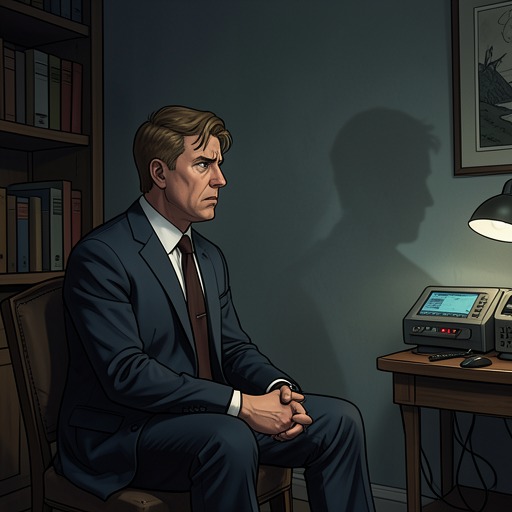
Straight ManRussell, Julie Devereaux’s husband, is a computer-software specialist whose domestic life becomes a test of what happens when financial optimism meets the consequences of a bad decision. He and Julie build a house they cannot comfortably afford, then face unemployment, mounting obligations, and a rupture in their marriage. His account of the incident that injures Julie never resolves into a complete explanation; instead, Russell remains fixed on the instant she fell. His eventual move to Atlanta, followed by Julie’s decision to join him, gives their separation a provisional ending rather than an uncomplicated cure.
Identity and the new house
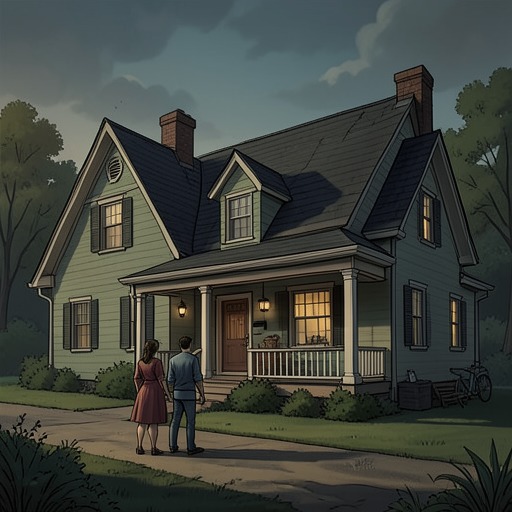
Russell enters the story through the house he and Julie have built in Allegheny Wells. The project is conspicuously modeled on the home of William Henry Devereaux, Jr. and Lily: Russell and Julie use their contractor and plans, and the finished house resembles it from the front. The resemblance becomes unmistakable to William Henry Devereaux, Jr. only when he notices the two decks, one in front and one behind. The house is therefore both a substantial financial commitment and a visible echo of Julie’s parents’ domestic life.
William Henry Devereaux, Jr. believes Julie and Russell cannot afford the construction, but Lily regards the house as a subject they have agreed not to raise. Her parents lend the couple money while trying to sustain the appearance of confidence in their judgment. Russell later acknowledges that the debt makes casual conversation with his father-in-law uncomfortable. The loan does not remove the pressure; it makes that pressure part of the family relationship.
Russell’s early attempts at homeownership also reveal a comic mismatch between the task and the man. William Henry Devereaux, Jr. finds him on the back deck, standing on the bottom rung of a stepladder with a flashlight and a large can of Raid, examining a wasps’ nest under the eaves and wondering whether the wasps are asleep. The scene presents Russell as a homeowner confronting the practical demands of the house without much confidence. It also places him, literally, beneath the eaves of an expensive commitment whose costs are already becoming difficult to manage.
Financial reversal
The financial strain begins with a decision Russell had expected to improve his prospects. He leaves a good job for what he believes will be a better one, only to learn that several large government loans needed to launch the project he is supposed to direct have not been approved. The delay could last months, perhaps a year. By the time he explains the situation, he is out of work; Julie’s salary as a service manager at a department store in the Railton Mall cannot plausibly support the household on its own, and Russell does some freelance software work.
The house makes the reversal concrete. The couple had built it on the expectation that their plans and income would hold; now mortgage payments are rising against falling personal income and savings. Julie’s parents have lent them money, but the family does not even have a clear shared understanding of how much. When Russell tells William Henry Devereaux, Jr. that they owe him too much to enjoy an ordinary conversation, the debt appears not as abstract financial assistance but as a barrier to ease between them.
Russell’s circumstances also show in his appearance. After a month or two without work, he looks about ten pounds heavier and less groomed than before. His hair, usually short and styled, has grown long and limp. William Henry Devereaux, Jr. realizes that he has not seen Russell or Julie for about a month, learning about their lives chiefly through Lily. The couple’s withdrawal from casual family contact parallels their dwindling financial room to maneuver.
Julie’s injury and Russell’s account
The marriage breaks into open conflict over a chair Julie buys for the guest room. She presents it as a bargain from a store going into bankruptcy: sixty percent off, for three hundred dollars. To Russell, even a reduced price is intolerable when they are so financially strapped that they cannot afford the purchase. The guest-room chair condenses their disagreement into an object: Julie treats the discount as a reason to buy, while Russell sees another expense they cannot bear.
After the confrontation, Julie arrives at her parents’ house with her left eye swollen almost shut, the same eye she injured as a child. She has packed suitcases and wants Russell out of the house. Asked whether he hit her, she first says that she fell, then explains that he shoved her and she fell. Her account establishes that Russell’s physical action preceded the injury, while the precise movement and degree of force remain disputed in his later telling.
Russell eventually waits more than an hour for William Henry Devereaux, Jr. and asks to talk over a beer. Before explaining himself, he admits that he has spent the weekend expecting his father-in-law to want to kill him. His story returns to the chair and to the moment he moved Julie aside. Russell says he may have been rough but insists that he did not push or shove her; he cannot understand why she ended up on the floor. His version does not undo Julie’s account, and the novel does not supply an outside resolution that settles the disagreement.
What William Henry Devereaux, Jr. observes is Russell’s inability to move beyond that moment. Russell does not ask how Julie is, which at first suggests indifference. But as he listens, William Henry Devereaux, Jr. suspects another explanation: Russell keeps seeing Julie on the floor, one hand clutching her injured eye, and cannot imagine what happened afterward. Days have passed, but in Russell’s mind the scene has no after. This fixation helps explain why he has not reached a conclusion about what he did or what the injury means. His account remains a replay rather than a settled defense.
Separation, disclosure, and departure
Julie’s separation from Russell is made practical as well as emotional. She returns to her parents’ home, while Russell later collects some clothes and other belongings from the house and showers there. Julie reacts angrily to the shower and announces that the locks are to be changed. When William Henry Devereaux, Jr. asks Meg Quigley about the situation, she confirms that she knows about Julie and Russell; Russell is not wholly absent, but remains nearby. The marriage’s break therefore unfolds through visits, missing belongings, locked doors, and the family’s partial knowledge rather than one decisive farewell.
Russell’s conversation with William Henry Devereaux, Jr. offers a chance to speak, but it does not immediately restore trust. Later, William Henry Devereaux, Jr. finds Russell asleep in Meg Quigley’s bed. The discovery sharpens the gap between what people know and what they tell: Russell is surprised to wake to his father-in-law, and the encounter adds uncertainty without establishing what, if anything, has occurred between Russell and Meg. William Henry Devereaux, Jr. is angry, though the fact that he is wearing Russell’s undershorts complicates the pose of moral certainty.
William Henry Devereaux, Jr. then directs Russell toward a job opportunity in Atlanta. Russell recognizes that his father-in-law is effectively sending him out of town, and recalls that Julie had told him about William Henry Devereaux, Jr.’s father leaving his family for a graduate student. That history helps Russell understand why the injury and separation have provoked such anger. At the airport, Russell puts up no real resistance, though he refuses to let William Henry Devereaux, Jr. carry either of his bags. He flies by way of Pittsburgh, with the return date left open, and accepts a check for expenses. His departure is at once employment advice and an intervention in Julie’s marriage crisis.
Reunion and narrative significance
The separation does not become permanent. Julie moves in with her parents temporarily after the house is rented, and Russell visits twice during that period. She later joins him in Atlanta, where she finds work and Russell is promoted. By the third week of August, a new family has rented the Allegheny Wells house with an option to buy. The place built as the couple’s anticipated home has become a temporary arrangement for someone else, while their own future shifts to another city.
The ending reports that Julie and Russell seem greatly relieved to be together again, but it does not erase the causes of their rupture. They had made a financially precarious investment, lost the expected income behind it, and suffered a physical and emotional crisis that Russell still cannot narrate with confidence. Their renewed closeness follows practical changes—relocation, work, and the rented house—not a fully described reconciliation. Russell’s arc is consequently less a triumph over one bad decision than a movement out of the frozen scene in which he had left Julie on the floor. He can take a job, accept help, and rejoin her, even while the account leaves the marriage’s deeper repair open.